Y-Design: A DFA Regional Convening
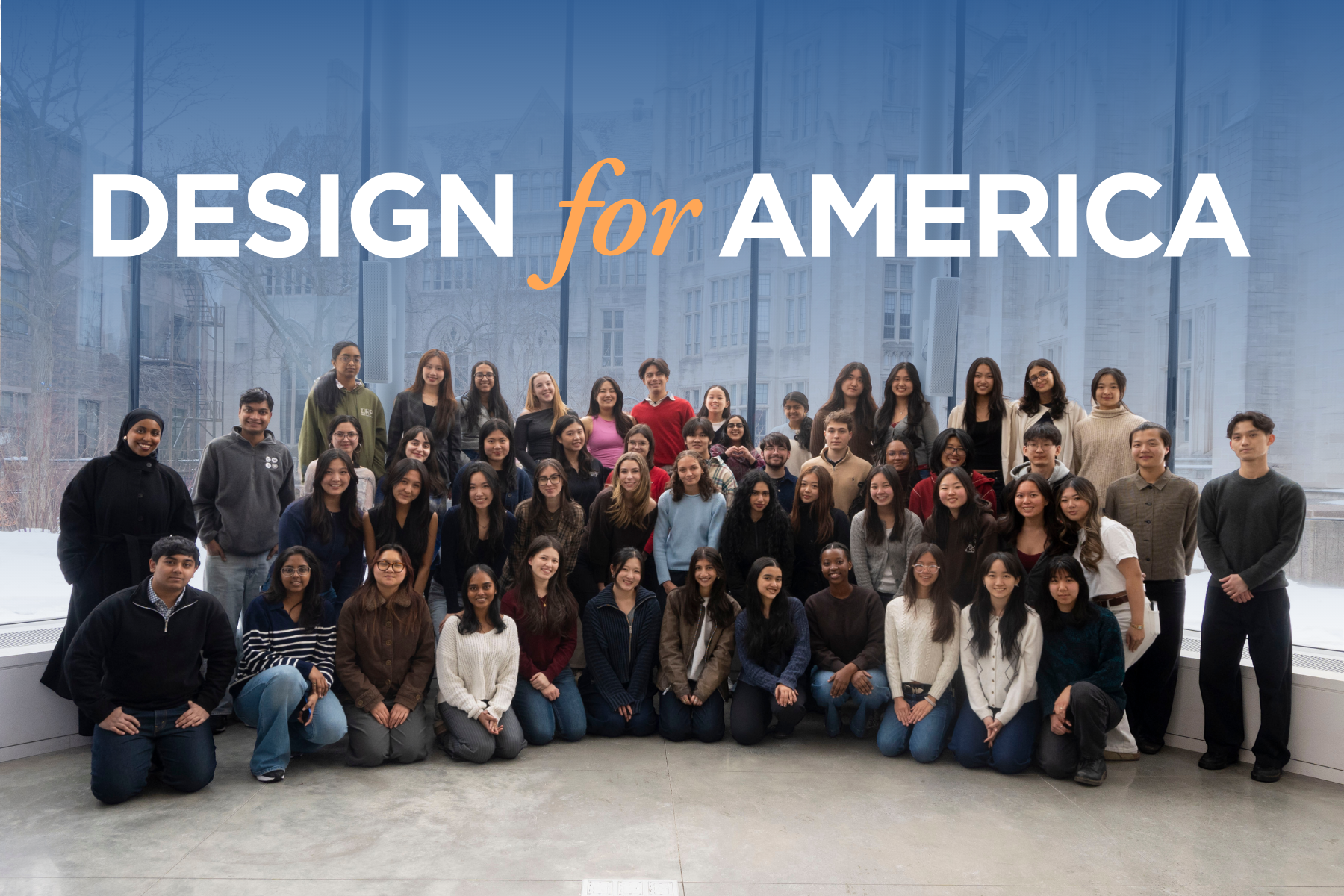
Y-Design was an East Coast convening hosted by the Design for America (DFA) Studio at Yale University. Held February 6–7 at Tsai CITY and the Mann Engineering Center, the event brought together eight DFA studios from across the Northeast network, including student members from Yale, MIT, Brown University, RISD, New York University, Fordham University, Macaulay Honors College (CUNY), and Barnard | Columbia University.
At its core, Y-Design was designed to strengthen the regional ecosystem of student-led studios committed to community-centered, human-centered design. DFA members are increasingly motivated to apply their skills beyond the classroom and to address complex social challenges, collaborate across disciplines, and develop solutions grounded in lived experience and community insight. Y-Design provided a structured environment for that exchange.
As one Macaulay Honors College student reflected:
“This trip not only made me excited about ideating and developing tangible solutions… but it also gave me hope for the future.”
The event unfolded in two intentional phases. The first evening centered on relationship-building through a DFA Social, creating an informal space for connection across campuses. The following day featured a full conference at Tsai CITY, including project showcases, hands-on workshops, and speaker sessions led by faculty and external partners.
For Mandy Chen, President of DFA Yale, hosting over 50 designers marked a milestone:
“I hosted my first multi-school design meetup with 50+ designers — and it was a blast.”
She noted one of the central lessons of the weekend:
“People love to talk (and that’s the point!) … the best moments happened when we simply created time for people to connect, share ideas, and learn from each other.”
Professors Alvin Ashiatey and Scott Petersen contributed an academic perspective, while Zach Bubolo of the Watson Foundation engaged directly with studios. For Alor Sahoo, Vice President of MIT DFA:
“One of the coolest parts of the mixer was talking to Zach Bubolo… Hearing about the intertwined relationship between the Watson Foundation and DFA… really helped put into perspective the magnitude of DFA’s existing impact.”
Y-Design was supported by the Tsai Center for Innovative Thinking at Yale (Tsai CITY), the Yale School of Engineering & Applied Science, and Design for America National. Their involvement reflects institutional alignment around interdisciplinary innovation, experiential learning, and student-driven impact.
What distinguished the weekend was not simply the programming, but the scale of shared reflection. One RISD/Brown member described the experience as:
“AWESOME! This experience helped me have a better understanding of the DFA community and differentiated DFA from other design-centred clubs.”
Another noted a professional shift:
“This event helped me envision my role better and understand how the artsy design aspect links with other aspects of design (i.e., business and economics).”
The structured studio rotations proved especially impactful. As MIT’s Alor Sahoo shared:
“All of the studios also spent an hour systematically rotating around, getting feedback from their projects, recruitment, and so on, from every other studio. I found this incredibly helpful…”
For Studio Leads, the exposure to different operating models was equally valuable:
“It was incredibly helpful to learn how other studio leads structure their organizations. Such as, how they pace projects (semester vs. year-long), approach recruitment, and build engagement within their studios.”
The event reinforced DFA’s distinctive value proposition. As one student concluded:
“The main takeaway is that Design for America is the model for what it means to invest in young people.”
Another reflected:
“It really reminded me of why I wanted to join DFA in the first place: to meet people outside of my school who also care about the human-centered design process.”
The purpose of the convening extended beyond a single weekend. By bringing multiple studios into one shared space, Y-Design strengthened peer accountability, accelerated idea exchange, and reinforced a collective regional identity.
Students did more than present their work; they refined their thinking, tested assumptions, and expanded their ambition. One student articulated this clearly:
“It is through this community that I feel empowered to tackle real-world, ‘unsolvable’ issues.”
For institutions invested in student leadership and applied learning, Y-Design demonstrates three measurable outcomes.:
Talent Development – Students practice research, facilitation, prototyping, and stakeholder engagement in real-world contexts.
Cross-Institution Collaboration – DFA studios build sustained relationships across universities rather than operating in isolation.
Momentum Toward Impact – Projects advance more rapidly when exposed to interdisciplinary feedback and regional insight.
As Mandy Chen reflected on the scale of what was built in just two months:
“Scale takes time… Now? We’re already dreaming bigger for next year.”
Y-Design represents a disciplined investment in student leadership and applied design education within Design for America. It is not merely a conference. It is infrastructure for cultivating the next generation of designers, innovators, and civic problem-solvers.
Video Credit to Yang Yang Ou of Macaulay Honors College Civic Futures Lab